
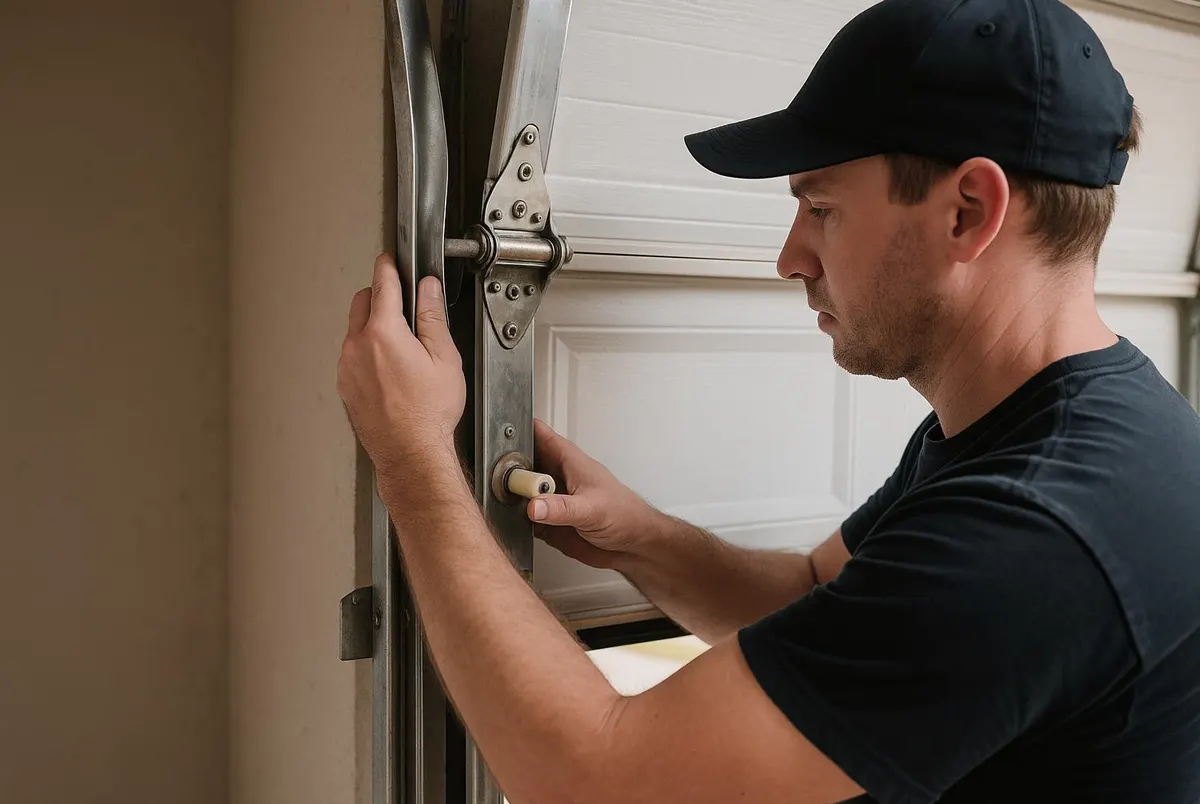
You walk in for an early workout and the mirror is fogged, there's a damp smell near the door, and a thin ring of rust has started along the bottom panel where none used to be. Or maybe the opener just refuses to close because a kettlebell rack is sitting a little too close to the track. Your spouse says it's nothing — "the garage isn't even a garage anymore." You're not so sure. Here's what's really going on.
The Garage Door Becomes the Weak Link in a Finished Space
When you insulate the walls, hang drywall, add a mini-split or space heater, and seal up a garage into a gym or workshop, you've created a conditioned room with one big exception: the garage door itself. Most garage doors, especially older steel ones, were never built to match the insulation value of a finished wall. That mismatch creates what's basically a cold (or hot) spot right in the middle of an otherwise comfortable room.
In Henry County, that mismatch gets exercised hard. Hot, humid summers push moisture-heavy air against a door that's cooler on one side than the other. Cold snaps and the occasional ice storm do the same thing in reverse. The result is condensation forming directly on the inside face of the door — which is exactly what you're seeing on the mirror and smelling near the frame. Left alone, that moisture sits against steel, and steel plus standing moisture equals rust, usually starting at the bottom panel where water tends to collect.
What Happens Mechanically When People "Just Stop Using" the Door
Here's where the argument usually starts. One spouse wants to treat the door like it doesn't exist anymore — stack weight plates against it, hang a mirror off the track rail, maybe even disconnect the opener and leave the door down permanently. The other spouse has a gut feeling that's not quite right. The gut feeling is correct.
- Torsion springs stay under tension whether the door opens or not. A closed door isn't a "dead" door — the springs are still doing their job holding the weight of the panels. Leaning heavy equipment against the door itself, rather than the wall, can bend panels or throw off the track alignment over time.
- Safety sensors don't know you turned the garage into a gym. If a yoga mat, weight bench, or storage bin ends up in front of the photo-eye sensors near the floor, the opener will refuse to close or will reverse unexpectedly. This is one of the most common service calls that starts with "we didn't change anything" — except something did get moved six inches to the left.
- Manual disengagement is riskier than people think. If someone pulls the emergency release to "just leave it down" permanently, the door is no longer connected to the opener's safety braking system. A door in that state can drop suddenly if the springs are even slightly out of balance, which is a real hazard in a room where someone might be standing underneath with free weights or power tools.
The Moisture Problem Deserves Its Own Conversation
This is the part that's specific to this climate, and it's worth taking seriously rather than painting over. The cycle of heavy rain, high summer humidity, and cold-weather temperature swings means an uninsulated or poorly sealed door in a now-conditioned room will keep producing condensation on a regular basis, not just once in a while. A few things make it worse:
- Weatherstripping that's cracked or compressed lets humid outside air leak in around the edges, where it meets the cooler conditioned air inside and condenses.
- Clogged weep holes or a bottom seal that's lost its shape let water pool instead of draining, which is how rust gets started at the bottom panel first.
- Pine pollen and debris around the garage opening can hold moisture against the seals longer than a cleaner surface would, especially after heavy rain.
None of this means the gym or workshop plan was a bad idea. It means the door needs to be brought up to the same standard as the rest of the room if you want it to hold up.
So, Who's Right?
Both of you, partly. You don't have to treat the garage door as off-limits or useless just because the room isn't for parking cars anymore. But it also can't be ignored or blocked like it's just a wall. The door still needs to open and close cleanly — for ventilation on brutal summer days, for moving equipment in and out, and for resale value, since a disabled or rusted-out garage door is an obvious red flag to any future buyer walking through a "finished" garage.
The fix usually isn't complicated: keep the opener connected and functional, keep the sensor path clear, replace worn weatherstripping and the bottom seal, and consider upgrading to an insulated door panel if condensation has become a recurring issue. None of that requires giving up the gym or the workshop.
When to Call McDonough Garage Door
If you're seeing condensation, rust starting at the bottom panel, a door that won't close because of sensor interference, or a door that feels heavier or lighter than it used to after a renovation, that's worth a real look. Our garage door maintenance visits check spring balance, track alignment, and sensor placement — all things that quietly shift once a garage gets reorganized into a living space. If the door itself is the moisture culprit, our garage door installation team can walk you through insulated panel options sized for how the room is actually being used now, not how it was used when the house was built.
If your garage has turned into a gym, workshop, or extra room and the door is acting up, giving off a musty smell, or just making you nervous, call McDonough Garage Door. We serve McDonough, GA and the surrounding Henry County area, and we'll tell you straight whether it's a quick fix or time for an upgrade.